AI Engineering · 10 min read
Why RAG Is Not Really About Giving an LLM More Context
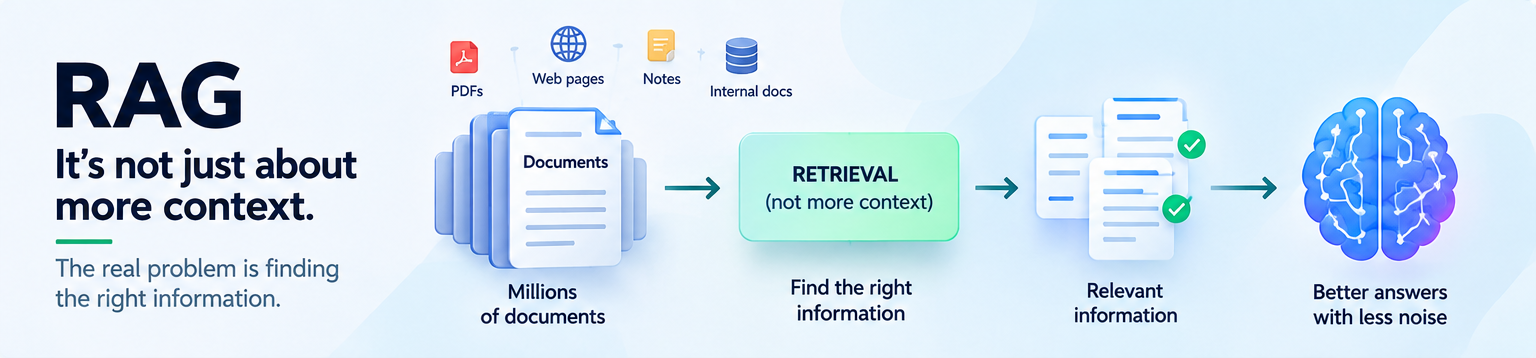
RAG is often explained as giving an LLM extra information. That misses the harder engineering problem: finding the right evidence from everything you could possibly give it.
Imagine your company has:
- 80,000 PDF files;
- years of Slack conversations;
- thousands of Jira tickets;
- product documentation;
- support conversations;
- engineering runbooks;
- HR policies;
- database records.
Now someone asks an AI assistant:
“What is our current reimbursement policy for international travel?”
A common explanation of RAG says:
Give the LLM your company documents so it has more context.
But which documents?
All 80,000 PDFs?
Every Slack message?
Every policy ever written?
That is where the simple explanation starts to break.
The real problem is not:
How do we give the model more information?
It is:
Out of everything we could give the model, how do we find the small amount of information that actually matters for this question?
That is the deeper idea behind Retrieval-Augmented Generation.
RAG is not mainly a “more context” system.
It is an information-selection system.
Start with an LLM that has no RAG
Suppose an employee asks:
“How much can I claim for a hotel in London?”
Without access to company information, the model has a problem.
Its training may have taught it what corporate travel policies usually look like.
But it does not know your current internal policy unless that information somehow appeared in its training --- and even then, it may be outdated.
So the system looks like:
Employee question
       ↓
      LLM
       ↓
Answer based on what the model already learned
The model may say something fluent.
Fluency is not evidence.
For private, recent or company-specific information, relying on model memory is the wrong architecture.
The obvious solution: give it the documents
Fine.
We have the travel-policy PDF.
Put it in the prompt.
Question
   +
Travel policy
   ↓
  LLM
   ↓
Answer
For one small document, this can work perfectly well.
And this is important:
Not every document question needs a full RAG system.
If you have one short document and it comfortably fits into the model’s context window, simply providing that document may be the simplest solution.
RAG becomes interesting when the information space gets much larger.
What happens when “just give it the context” stops scaling?
Now imagine the assistant serves the whole company.
The answer might live in:
Travel Policy 2024.pdf
Travel Policy 2025.pdf
Travel Policy 2026.pdf
London Expense Exceptions.pdf
Finance FAQ
HR handbook
Slack #travel
Confluence
Jira
The knowledge base may contain millions of pieces of text.
You could try to send everything.
But now you have several problems.
Problem 1: the context window is finite
A context window is the amount of input a model can consider for a request, usually measured in tokens.
A token is roughly a small piece of text --- not exactly a word, but close enough for this mental model.
Your company knowledge base can be vastly larger than any practical request context.
So some selection has to happen.
Problem 2: input is not free
More input generally means more processing.
Depending on the model and provider, that can increase cost and latency.
Sending 500 pages to answer a question whose answer lives in one paragraph is computationally wasteful.
Problem 3: more information can mean more noise
Suppose the prompt contains:
2024 travel policy
2025 travel policy
2026 travel policy
old Slack discussion
draft reimbursement proposal
current finance FAQ
Now the model has more context.
But is it better context?
The old policy says £180.
The new policy says £220.
A draft says £250.
A Slack message says the limit might change next quarter.
The challenge is no longer lack of information.
It is finding authoritative, relevant information.
This is the key shift.
Retrieval enters before generation
Instead of pushing the entire knowledge base into the model, search it first.
User question
      ↓
Search the knowledge base
      ↓
Retrieve the most relevant evidence
      ↓
Question + evidence
      ↓
LLM
      ↓
Answer
That search step is retrieval.
The model is no longer expected to search your entire company knowledge by itself.
The application narrows the information first.
Then generation happens.
Hence:
Retrieval-Augmented Generation.
TechByteByByte’s existing RAG course makes this distinction explicit: retrieval and generation are separate concerns. Retrieval asks, “Did we find the right information?” Generation asks, “Given that information, did the model produce a good answer?”
That separation is one of the most useful ideas in production RAG.
A tiny example makes the difference obvious
Imagine the knowledge base contains 1,000 chunks.
A chunk is simply a smaller piece of a larger document that can be searched independently.
The user asks:
“What is the London hotel reimbursement limit?”
A retrieval system might return:
Chunk #184
2026 International Travel Policy
London hotel reimbursement limit: £220 per night.

Chunk #612
Expense claims must be submitted within 30 days.

Chunk #402
International travel requires manager approval.
The application builds a prompt containing the question and those selected pieces.
QUESTION:
What is the London hotel reimbursement limit?

EVIDENCE:
2026 International Travel Policy:
London hotel reimbursement limit: £220 per night.

INSTRUCTION:
Answer using the supplied evidence.
The LLM now has a much easier job.
It does not need to know the policy.
It needs to use the policy we found.
But how does retrieval know what is relevant?
This is where RAG gets more technical.
A simple system might use keyword search.
Question:
London hotel reimbursement limitSearch documents containing:
London
hotel
reimbursement
limitThat can work.
But language is messy.
The document may say:
“Maximum lodging allowance for the UK capital…”
The user said “London hotel limit.”
Same idea.
Different words.
This is one reason many RAG systems use embeddings.
An embedding converts text into a vector --- a list of numbers designed so that semantically related text can be compared mathematically.
Conceptually:
"London hotel reimbursement"
           ↓
     Embedding model
           ↓
 [0.18, -0.42, 0.71, ...]


"UK capital lodging allowance"
           ↓
     Embedding model
           ↓
 [0.21, -0.39, 0.69, ...]
The numbers are not meaningful to a human one by one.
Their position in the embedding space helps the retrieval system find semantically similar content.
This enables dense retrieval.
But embeddings are not RAG.
A vector database is not RAG either.
They are tools that can help implement the retrieval stage.
The architecture is the important part:
Find useful evidence
        ↓
Give evidence to model
        ↓
Generate grounded answer
This is why retrieval quality can matter more than model size
Imagine we have the world’s strongest LLM.
But retrieval returns the 2024 policy.
The model may produce a beautifully written, perfectly reasoned, completely wrong answer:
“The London hotel limit is £180.”
Now use a somewhat weaker model.
Retrieval returns the correct 2026 policy.
The model says:
“The current London hotel reimbursement limit is £220 per night.”
Which system is better?
The second one.
This reveals an important production lesson:
A powerful generator cannot reliably repair evidence it never received.
This is why retrieval should be evaluated separately.
If the final answer is wrong, ask:
Did retrieval find the right evidence?
            ↓
          YES
            ↓
Did generation use it correctly?


Did retrieval find the right evidence?
            ↓
           NO
            ↓
Fix retrieval first
Without this separation, teams often blame the LLM for a search problem.
“Top 5 closest chunks” is only the beginning
Basic RAG is often taught like this:
Document
  ↓
Chunk
  ↓
Embed
  ↓
Vector database
  ↓
Similarity search
  ↓
Top 5 chunks
  ↓
LLM
That is useful for learning.
Production retrieval can become much more sophisticated.
Why?
Because “mathematically similar” and “best evidence for this question” are not always identical.
A production system may add:
- keyword search;
- dense retrieval;
- metadata filtering;
- hybrid search;
- query rewriting;
- reranking;
- recency rules;
- permissions;
- source authority;
- duplicate removal;
- context construction.
Imagine searching for:
“Java 21 migration issue in payment-service”
Dense semantic search might find documents about Java migrations.
Keyword search may be particularly valuable for the exact string
payment-service and version 21.
Hybrid retrieval can use both signals.
Then a reranker can take the initial candidates and more carefully score which ones truly answer the query.
So real retrieval may look like:
Question
   ↓
Query understanding
   ↓
┌───────────────────┐
│ Keyword retrieval │
│ Dense retrieval   │
└───────────────────┘
   ↓
Candidate chunks
   ↓
Metadata / permission filtering
   ↓
Reranking
   ↓
Best evidence
   ↓
LLM
Now RAG looks less like “stuff documents into an LLM.”
It looks like a search-and-evidence system.
That is exactly what it is.
The hidden problem: chunks can be correct and still useless
Suppose retrieval finds:
“…the maximum is £220 per night.”
Great.
Maximum what?
Where?
For whom?
The chunk was technically relevant but lost its surrounding meaning when the document was split.
This is why context construction matters.
The system may need to preserve:
- document title;
- section heading;
- surrounding paragraph;
- date;
- source;
- metadata.
Instead of:
£220 per nightgive the model:
Source: International Travel Policy 2026
Section: United Kingdom — Accommodation

For London, the maximum reimbursable hotel rate
is £220 per night.
The second piece is much more useful evidence.
Retrieval is not only about finding something nearby.
It is about delivering evidence the model can actually use.
Permissions are part of retrieval too
Imagine an internal assistant.
An employee asks:
“What salary adjustment did the executive team approve?”
The most semantically relevant document may be confidential.
Should retrieval return it?
No.
A production knowledge system needs access control.
Question
   ↓
Who is asking?
   ↓
What are they allowed to access?
   ↓
Search permitted knowledge
   ↓
Return relevant evidence
If permission filtering happens after confidential text has already been placed in the model context, you may already have created a security problem.
This is another reason RAG is better understood as a system rather than a vector-database feature.
What about million-token context windows?
This is where the conversation gets interesting.
Modern models can accept much larger contexts than early LLMs.
So a reasonable question is:
If the model can read an enormous amount of text, why retrieve anything?
Sometimes, you genuinely may not need retrieval.
Suppose:
- the corpus is small enough;
- it changes infrequently;
- the whole corpus fits comfortably;
- latency and cost are acceptable;
- you need reasoning across many parts of the corpus.
Giving the model the whole corpus can be simpler.
That is good engineering.
Do not add a vector database merely because someone said every AI app needs RAG.
But a large context window does not eliminate the information-selection problem for large or dynamic systems.
Imagine:
10 documents → maybe send all

10,000 documents → selection becomes useful

10 million documents → selection is unavoidable
And size is not the only reason.
Retrieval can help with:
- permissions;
- freshness;
- source attribution;
- reducing irrelevant information;
- lower input volume;
- targeted updates;
- evidence selection.
So the real comparison is not:
RAG vs long contextIt is:
For this application, what is the best way to select and supply the information the model needs?
Sometimes that is retrieval.
Sometimes long context.
Sometimes both.
RAG does not “teach” the model your documents
This misconception is worth removing completely.
When RAG retrieves a policy and puts it into the prompt, the model’s parameters do not change.
Training / fine-tuning

Documents
   ↓
Learning process
   ↓
Model weights change


RAG

Documents
   ↓
Retrieve relevant text
   ↓
Put text in this request
   ↓
Model weights stay the same
That is why updating a RAG knowledge base can be fast.
If the travel policy changes tonight, you can update the source.
Tomorrow’s retrieval can return the new policy.
You do not necessarily need to retrain the LLM.
RAG does not eliminate hallucination either
Another dangerous simplification is:
RAG prevents hallucination.
It can reduce certain hallucinations by grounding generation in real evidence.
But failure can still happen.
Retrieval can find the wrong information.
The source itself can be wrong.
The model can ignore good evidence.
Conflicting documents can exist.
A prompt-injection attack can live inside retrieved content.
The model can make an unsupported leap beyond the evidence.
A trustworthy RAG system therefore needs evaluation.
Not just:
Did the chatbot answer?
But:
Retrieval:
Did we find the correct evidence?

Generation:
Did the answer follow the evidence?

Grounding:
Are the claims actually supported?

Citation:
Can the user verify the source?
That is production RAG.
The architecture changes when you adopt this mental model
If you think:
RAG = connect LLM to vector DB
you will spend most of your time choosing a database.
If you think:
RAG = find the best evidence for a question and help a model answer from it
you start asking better questions:
- What makes a source authoritative?
- How should documents be chunked?
- How do we evaluate retrieval?
- Should we combine keyword and semantic search?
- How do we handle dates?
- How do permissions work?
- What if sources conflict?
- How do we rerank candidates?
- How much context should we finally give the model?
- How do we show citations?
- How do we detect unsupported answers?
Those are the questions that determine whether the system is useful.
One picture to remember
Do not picture RAG as:
Documents ──────────────→ LLM
       "give it more stuff"
Picture it as:
                HUGE KNOWLEDGE BASE
                       │
                       │
                       ▼
User question ───→ RETRIEVAL
                       │
                       ▼
               Best useful evidence
                       │
                       ▼
                Context construction
                       │
                       ▼
                Question + evidence
                       │
                       ▼
                      LLM
                       │
                       ▼
              Grounded answer + source
The important box is not only the LLM.
It is the narrowing funnel before it.
The takeaway
RAG is often introduced as a way to “give an LLM more context.”
That is technically true but conceptually incomplete.
The hard production problem is usually the opposite:
You have far too much possible context. Which tiny fraction of it deserves to reach the model for this particular question?
RAG solves that problem by separating retrieval from generation.
First find the evidence.
Then let the model reason and write with that evidence.
Once you understand RAG this way, embeddings, vector databases, chunking, reranking, hybrid search and context construction stop looking like disconnected buzzwords.
They are all attempts to answer one question better:
What information should the model see right now?
Related learning